


QUICK LINKS

Shower water purity standards: What beauty-focused women need to know
TL;DR:
- Australian shower water meets health standards, but aesthetic parameters like chlorine and hardness affect hair and skin clarity. Filtering water reduces mineral and chemical impact, enhancing beauty outcomes by preventing dryness, frizz, and sensitivity. Personalised filtration systems ensure optimal water quality, transforming your shower into a wellness asset for daily skincare and haircare.
Most Australians trust their tap water without question, and for drinking purposes, that confidence is largely well-placed. But when it comes to your shower, simply being “safe to drink” doesn’t tell the whole story. The water hitting your scalp and skin every morning contains chlorine, dissolved minerals, and other parameters that are technically within health guidelines yet quietly working against your hair and skin. This guide unpacks exactly what purity standards apply to your shower water, why aesthetic factors are the ones your beauty routine actually depends on, and what you can do to optimise your shower water for real, measurable results.
Table of Contents
- What are purity standards for shower water in Australia?
- Why aesthetic water factors matter for hair and skin
- The science: How shower water quality affects your beauty routine
- Practical steps: How to assess and optimise your shower water quality
- What most guides miss: Applying science to your unique beauty routine
- Upgrade your shower water: Achieve beauty and wellness with PURITI
- Frequently asked questions
Key Takeaways
| Point | Details |
|---|---|
| Australian standards apply | Your shower water must meet strict national guidelines—even if standards are aimed at drinking water. |
| Aesthetic factors affect beauty | Chlorine and hardness in ‘safe’ water can still impact hair, skin, and wellness results. |
| Personal testing recommended | DIY or lab testing reveals the real impact of your water on beauty routines. |
| Filtration optimises outcomes | High-end filters can transform basic water quality into a true self-care advantage. |
What are purity standards for shower water in Australia?
The Australian Drinking Water Guidelines (ADWG) set the national purity standards for tap water, and because your shower draws from the same municipal supply as your kitchen tap, these same guidelines govern what flows through your showerhead. The ADWG covers everything from microbial safety and chemical contaminants to physical and aesthetic properties like taste, odour, and appearance.
There are no specific shower-only standards in Australia. Guideline values are derived primarily from ingestion data, though dermal and inhalation exposure pathways are factored in conservatively, typically accounting for around 10 to 20 per cent of total intake. In practice, this means your water supplier is optimising for health safety, not for how your hair cuticle responds.
The key parameters most relevant to your shower experience are summarised below.
| Parameter | Health guideline | Aesthetic guideline | Typical Australian range |
|---|---|---|---|
| Free chlorine | 5 mg/L | 0.6 mg/L | 0.5 to 2.5 mg/L |
| Hardness (as CaCO3) | No health limit | 200 mg/L | 10 to 300+ mg/L |
| pH | No health limit | 6.5 to 8.5 | 7.0 to 8.0 |
| Fluoride | 1.5 mg/L | No aesthetic limit | 0.6 to 1.1 mg/L |
Notice the distinction between health guidelines and aesthetic guidelines. Health guidelines are set to protect you from illness or long-term harm. Aesthetic guidelines reflect what most people find acceptable in terms of taste, smell, and appearance. Neither is specifically calibrated to the condition of your hair follicles or skin barrier.
“ADWG ensures that even what touches your skin is well regulated, but it is not tailored to beauty outcomes.”
Understanding this gap is the first step. Your water can tick every health box and still be working against your beauty routine. To understand how shower vs tap water impacts differ in practice, it is worth looking more closely at the aesthetic parameters in action.
Why aesthetic water factors matter for hair and skin
While the ADWG’s standards are designed to protect your overall health, there’s more to consider when beauty and wellness are your focus. Chlorine and hardness are the two parameters you’re most likely to encounter at levels that affect your hair and skin, and both fall within the aesthetic category rather than the health category.
The ADWG health guideline for free chlorine sits at 5 mg/L, but the aesthetic guideline for taste and odour is just 0.6 mg/L. Typical Australian tap water runs between 0.5 and 2.5 mg/L. That means your shower water can contain chlorine at several times the aesthetic guideline level and still be considered perfectly safe to drink. From a beauty standpoint, however, chlorine at these concentrations strips the natural oils from both skin and scalp, disrupts the moisture balance your hair products are trying to restore, and can react with some conditioning agents to reduce their effectiveness.
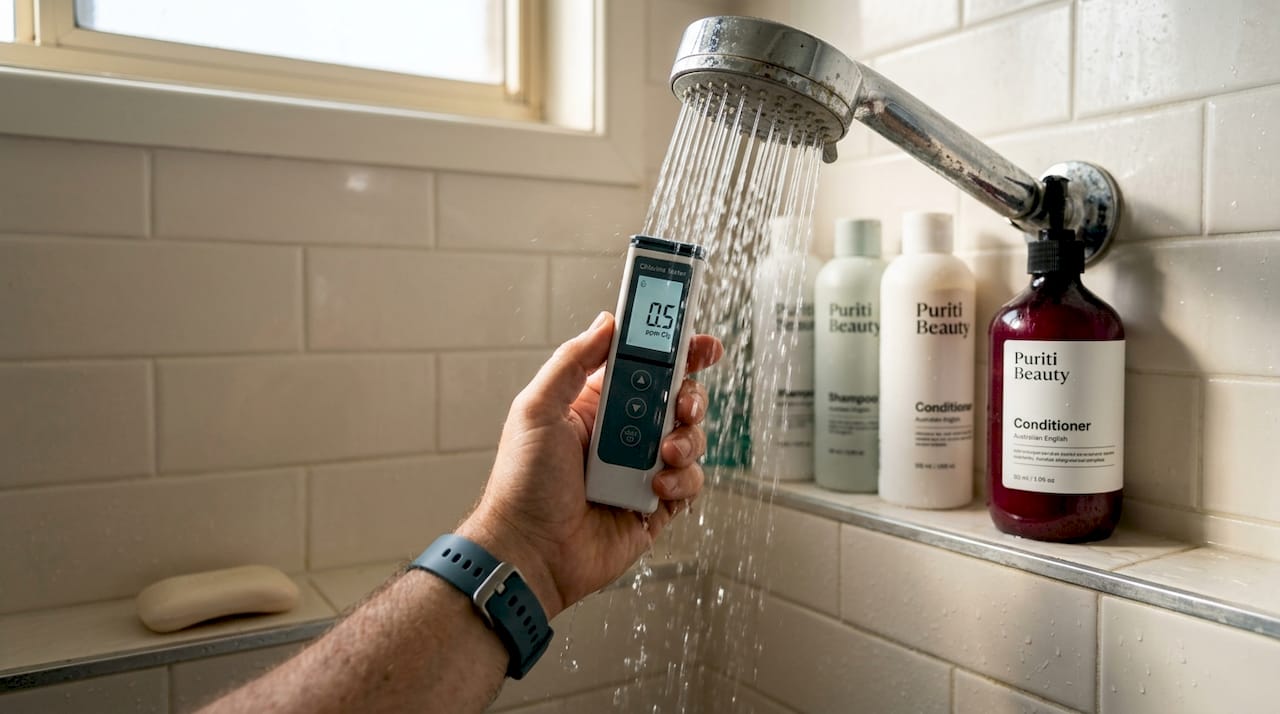
The ADWG aesthetic guideline for hardness is 200 mg/L as CaCO3, with no associated health risk at this level. But hard water deposits calcium and magnesium ions that coat your hair shaft, interfere with lathering, and leave a film on your skin after every shower. In high-hardness areas, which include many parts of urban Australia, this accumulation is continuous and cumulative.
Research has found a compelling connection between hard water and skin conditions. Hard water areas show a 54 per cent higher risk of eczema in children, a figure that underlines the real-world skin impact of water hardness even when it presents no formal health concern.
Visible beauty impacts of chlorine and hardness:
- Hair: Dryness, increased frizz, colour fade faster than expected, reduced shine, and a dull, lifeless appearance
- Scalp: Irritation, increased flaking, and disruption to the natural sebum balance
- Skin: Tightness after showering, accelerated moisture loss, sensitivity, and worsening of conditions like eczema or psoriasis
- Product performance: Reduced lather from shampoos and body washes, shampoo and conditioner needing to work harder to overcome mineral deposits
- Hair colour: Chlorine and hard water minerals accelerate colour fade and can cause unwanted tonal shifts, particularly in blonde and highlighted hair
The best water filters for beauty outcomes specifically target these aesthetic parameters. This is where the gap between a health-focused regulatory framework and a beauty-focused approach becomes most visible. Exploring chlorine removal tips is a practical starting point for addressing the most common aesthetic issue in Australian shower water.
The science: How shower water quality affects your beauty routine
The impacts aren’t just theoretical. Here’s how your hair and skin actually respond to different water qualities during every shower.
Hot water causes your pores to open and your hair cuticle to expand. In this state, your skin and scalp are more absorbent. Chlorine and dissolved minerals enter the picture at precisely the moment your skin is most vulnerable to their effects. Studies confirm that hot showers amplify the uptake of chemicals through open pores, making the case for better shower water quality significantly stronger than it would be for cold-water exposure.
The ADWG pH aesthetic guideline sits between 6.5 and 8.5, with typical Australian tap water ranging from 7.0 to 8.0. Your skin’s natural pH is slightly acidic, around 4.5 to 5.5. When shower water has a higher pH, even within the acceptable range, it can disrupt your skin’s acid mantle, the protective barrier that keeps moisture in and irritants out.
Here’s the sequence of events from water to wellness outcome:
- Hot water opens pores and lifts the hair cuticle, maximising exposure to dissolved minerals and chlorine
- Chlorine strips lipids from the skin surface, reducing the skin’s ability to retain moisture
- Calcium and magnesium ions bond to the hair shaft, increasing porosity and creating a rough, dull texture
- pH mismatch between water and skin disrupts the acid mantle, weakening barrier function and increasing sensitivity
- Conditioning and moisturising products must work against mineral deposits rather than delivering their full benefit
- Over time, cumulative exposure compounds these effects, making hair and skin progressively harder to manage
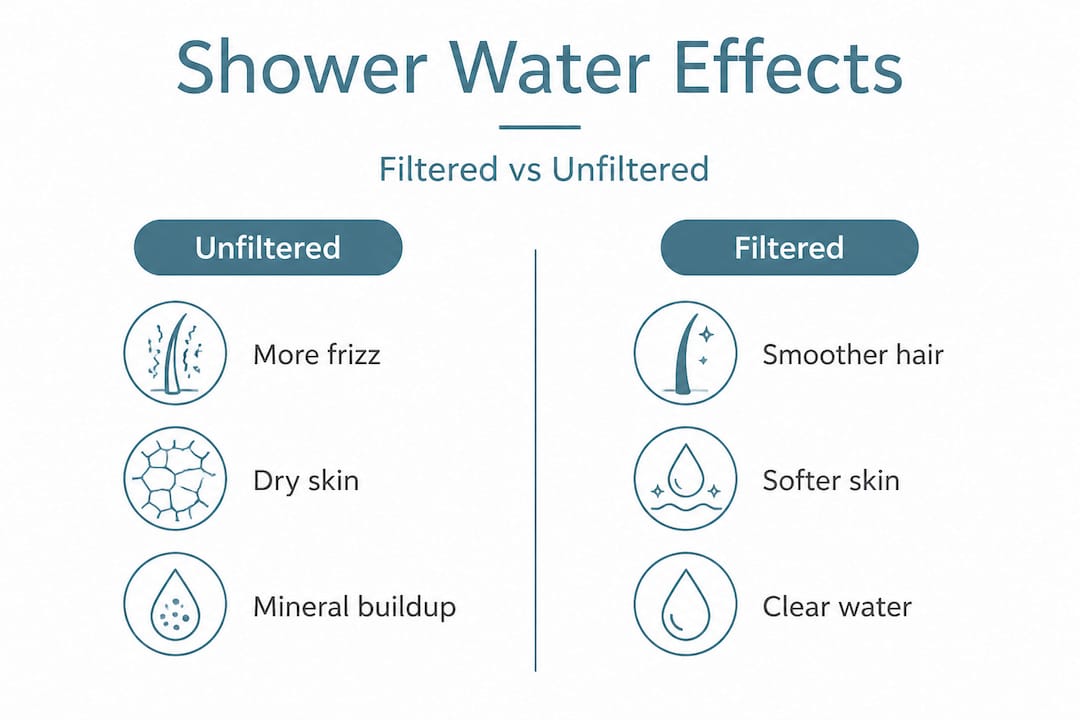
| Issue | Unfiltered shower water | Filtered shower water |
|---|---|---|
| Hair frizz | High, especially in hard water areas | Noticeably reduced |
| Scalp dryness | Common, chlorine strips oils | Minimised |
| Skin tightness post-shower | Frequent | Rare |
| Product effectiveness | Reduced by mineral build-up | Maximised |
| Hair colour longevity | Shortened, colour strips faster | Extended |
| Eczema-prone skin | Risk elevated | Risk reduced |
Pro Tip: If your conditioning treatments, hair masks, or moisturisers aren’t performing the way the product promises, your shower water may be the reason. Try the improve shower water guide before investing in more expensive products. Many women find that addressing water quality at the source delivers results that no product alone can replicate.
Understanding how filtration systems affect skin and hair gives you a clear picture of the mechanism behind these improvements.
Practical steps: How to assess and optimise your shower water quality
Ready to take action? Here’s how you can analyse and upgrade your own shower water for real beauty and wellness benefits.
The first step is knowing what you’re working with. Many Australians don’t realise that their local water provider publishes annual water quality reports, which include chlorine levels, hardness, and other key parameters. These are publicly available and typically searchable by suburb or postcode. As a starting point, this costs nothing and gives you a reliable baseline. You can also explore shower testing methods in more detail, including DIY test kits that measure chlorine, hardness, and pH at home within minutes.
Here’s a practical step-by-step process:
- Download your local water quality report from your supplier’s website and note the chlorine and hardness figures
- Purchase a home water test kit to cross-check at your actual shower point, as chlorine can vary between the treatment plant and your tap
- Assess your hair and skin baseline by noting current concerns, dryness, frizz, colour fade, or sensitivity, before making any changes
- Research filtration options that specifically target chlorine and hardness, looking for lab-tested, multi-stage filters rather than single-stage options
- Install a quality shower filter and give it four to six weeks to observe consistent improvements in hair and skin condition
- Replace filter cartridges on schedule as specified by the manufacturer, as a saturated filter will stop removing contaminants effectively
On the topic of filtration stages, multi-stage filters are meaningfully more effective than single-media options. A five-stage system, for example, can address chlorine, heavy metals, sediment, and pH adjustment in sequence, each stage tackling what the last couldn’t. Single-stage carbon-only filters often struggle to perform at higher flow rates and temperatures, both of which are typical of a warm shower.
Note that fluoride health guidelines set a ceiling of 1.5 mg/L with a target range of 0.6 to 1.1 mg/L in most Australian supplies. While fluoride is less relevant to beauty outcomes than chlorine or hardness, it’s worth understanding the full mineral profile of your water, particularly if you have sensitive skin.
Pro Tip: For those with sensitive skin or scalp conditions, look specifically for filters tested and certified for sensitive-skin use. The right filters for sensitive skin are designed to deliver gentler water without reducing flow pressure, making the upgrade both effective and seamless.
What most guides miss: Applying science to your unique beauty routine
Most conversations about water quality stop at “is it safe?” That’s an important question, and the answer in Australia is almost always yes. But stopping there is like stopping a skincare assessment at “is the product not expired?” Safety is the floor, not the ceiling.
The ADWG prioritises ingestion safety above all else, and this is entirely appropriate for a public health framework. However, dermatologists and hair specialists consistently note that aesthetic parameters like chlorine concentration and water hardness influence hair and skin outcomes in ways the regulatory framework was never designed to address. These are not regulatory failures. They are simply different objectives.
The uncomfortable truth is that many people invest significantly in premium skincare, high-end haircare, and elaborate beauty routines while the variable with the most consistent daily contact with their skin and hair remains completely unaddressed. Your shower water contacts 100 per cent of your skin and scalp, every single day, for an average of eight minutes at a time. No serum, mask, or treatment even comes close to that level of exposure.
We see this gap consistently. Someone spending well over $100 per month on haircare products is showering in water with 1.5 mg/L of chlorine and hardness levels above the aesthetic guideline, then wondering why their products aren’t delivering. The science behind filtration is not complicated. It’s simply a step that most beauty guides skip because it sits outside the product category they’re discussing.
The most effective beauty routines are those that treat water quality as a foundational variable, not an afterthought. Personalising your approach means knowing your specific water profile, understanding which parameters matter most for your individual hair and skin concerns, and selecting filtration that is matched to that profile. This is what separates a genuinely optimised routine from one that’s merely well-intentioned.
Upgrade your shower water: Achieve beauty and wellness with PURITI
If you’re committed to transforming your shower into a wellness asset, here’s how you can start today.
PURITI is Australia’s premium shower filter, independently lab-tested to remove 99.55% of chlorine and contaminants from your shower water. The results are published publicly so you can verify exactly what you’re getting before you buy. The five-stage filtration system is built from aluminium titanium alloy and designed to sit beautifully in any premium bathroom.
The premium shower filter installs in minutes without a plumber and delivers measurably cleaner, softer water from the first shower. When your cartridge needs replacing, the refill cartridge keeps your filtration performing at full capacity without any guesswork. You can explore the full range and find the right solution for your bathroom at the PURITI shower collection. This is the Step Zero of a beauty routine built on evidence, not assumptions.
Frequently asked questions
Is shower water purity really different from drinking water?
No, shower water is held to the same purity standards as drinking water because both come from the same municipal supply. The ADWG applies equally to all water delivered through the municipal network, including your showerhead.
What is the ideal chlorine level in shower water for beauty?
For beauty outcomes, lower than 0.6 mg/L is ideal. The ADWG aesthetic guideline for taste and odour is 0.6 mg/L, but reducing chlorine below this threshold also benefits hair texture and skin moisture retention significantly.
Does hard water make a noticeable difference to my skin or hair?
Yes, hard water leaves mineral deposits on both skin and hair that cause dryness, roughness, and reduced product effectiveness. While the ADWG aesthetic guideline sets 200 mg/L as CaCO3 as acceptable, beauty outcomes benefit from levels well below this threshold.
How do I know if my shower water meets purity standards?
Check your local water provider’s annual quality report online, which lists chlorine, hardness, pH, and fluoride figures for your area. For a more precise reading at your actual showerhead, a DIY test kit from a hardware or pool supply store takes less than five minutes to use.
Are filters the only way to improve shower water for beauty?
Filters are the most reliable and consistent solution for reducing chlorine and hardness in shower water. Routine cleaning of your showerhead and adjusting your product routine can offer partial relief in hard water areas, but filtration is the only approach that addresses the source directly.


