


QUICK LINKS

How household filtration systems transform skin and hair
TL;DR:
- Filtering shower water removes chlorine and heavy metals, improving skin hydration and hair shine.
- Multi-stage filters with KDF-55 and activated carbon are most effective for health and beauty benefits.
- Regular maintenance and certified filters ensure consistent water quality and optimal skin and hair results.
Your skincare shelf might be stocked with premium serums and your hair routine carefully curated, yet if you’re showering in unfiltered tap water, you could be working against yourself every single day. Chlorine, heavy metals, and sediment in unfiltered shower water strip moisture from skin, dull your hair’s natural shine, and aggravate sensitive scalps. What touches your skin and hair for 8 to 10 minutes every morning matters far more than most beauty advice acknowledges. This guide walks you through exactly how household filtration systems work, what to look for, and how the right filter can become the most important step in your entire beauty routine.
Table of Contents
- How household filtration systems work
- Key benefits of shower filtration for beauty and wellness
- Types of shower filtration systems explained
- Shopping smart: What certifications and features matter
- Maintenance tips for lasting beauty results
- What most guides miss about household filtration and beauty
- Ready to upgrade your shower routine?
- Frequently asked questions
Key Takeaways
| Point | Details |
|---|---|
| Shower filters protect beauty | Filtering your shower water reduces chlorine and metals that can harm skin and hair. |
| Choose certified filters | Look for NSF/ANSI-certified filters with proven performance, especially for Australian water. |
| Maintenance is essential | Replacing cartridges regularly ensures your filter keeps working for your wellbeing. |
| Filter type affects results | The right filtration media—like KDF-55—is key to maximising beauty and wellness benefits. |
How household filtration systems work
Understanding filtration starts with knowing there are two distinct categories. Household filtration systems are categorised into Point-of-Entry (POE) whole-house systems and Point-of-Use (POU) systems like shower filters. POE systems treat every drop of water entering your home, while POU systems target a single fixture, giving you precision filtration exactly where it counts for your beauty routine.
Each system relies on one or more core filtration technologies. Here is what each does:
- Mechanical sediment filtration: Physically traps particles like rust, dirt, and sand before they reach your skin.
- Activated carbon: Adsorbs chlorine, chloramines, and volatile organic compounds (VOCs) that cause dryness and odour.
- Ion exchange: Swaps calcium and magnesium ions (the minerals that make water “hard”) for sodium or hydrogen ions, softening the water.
- KDF-55 (Kinetic Degradation Fluxion): Uses a redox reaction to convert free chlorine into harmless chloride, highly effective in both hot and cold water.
- Reverse osmosis (RO): Forces water through a semi-permeable membrane, removing up to 99% of dissolved contaminants.
- UV treatment: Uses ultraviolet light to neutralise bacteria and viruses without adding chemicals.
For beauty and wellness purposes, the science behind water filtration shows that removing chlorine and heavy metals is the highest priority. Chlorine is added to Australian municipal water to kill pathogens, which it does effectively, but it does not stop working once it hits your skin. It continues to oxidise, stripping the skin’s natural lipid barrier and pulling moisture from your hair shaft.
| Filtration type | What it removes | Best suited for |
|---|---|---|
| Activated carbon | Chlorine, VOCs, odour | City water, chemical reduction |
| KDF-55 | Chlorine, heavy metals, bacteria | Hot showers, high-chlorine areas |
| Ion exchange | Calcium, magnesium (hardness) | Hard water regions |
| Reverse osmosis | Most dissolved solids | Drinking water, whole-house POE |
| UV treatment | Bacteria, viruses | Bore water, rural supply |
For most Australian women using city water, a multi-stage POU shower filter combining KDF-55 and activated carbon delivers the most targeted, cost-effective upgrade for daily skin and hair health.
Key benefits of shower filtration for beauty and wellness
Once you understand the mechanics, the beauty case for shower filtration becomes straightforward. Shower filtration systems primarily use KDF-55 for chlorine and heavy metal removal, calcium sulfite for hot water chlorine neutralisation, activated carbon for VOCs, and Vitamin C as an additional neutralising agent. Together, these media address the specific contaminants that most directly affect your appearance.
Here is what filtered shower water can do for you:
- Skin hydration: Without chlorine stripping your skin’s natural oils, your moisturiser absorbs better and your skin stays hydrated longer between applications.
- Reduced irritation: For women with eczema, rosacea, or sensitive skin, removing chemical irritants from shower water can noticeably reduce redness and itching.
- Scalp health: Chlorine and hard water minerals accumulate on the scalp, contributing to dryness, flaking, and product buildup. Filtered water reduces this cycle.
- Hair texture: Filtered water allows your hair cuticle to lie flatter, resulting in smoother, shinier, more manageable hair.
- Colour longevity: If you colour your hair, chlorine accelerates fade. Filtered water meaningfully extends the life of your colour treatment.
“Removing chlorine and heavy metals from shower water is one of the most direct and immediate improvements you can make to the quality of water contacting your skin and hair daily.”
These benefits compound over time. Better-quality water means your tools for healthy hair and conditioning treatments work harder because they are not fighting against a constant chemical load. The improvement is not subtle once you have experienced it.
Pro Tip: Choose a multi-stage filter that includes KDF-55 specifically. Single-stage carbon filters alone are less effective in hot water, and hot showers are precisely when chlorine absorption through skin and lungs is highest.
Types of shower filtration systems explained
Not all shower filters are built the same. Knowing the differences helps you pick the right one without overspending or under-performing.
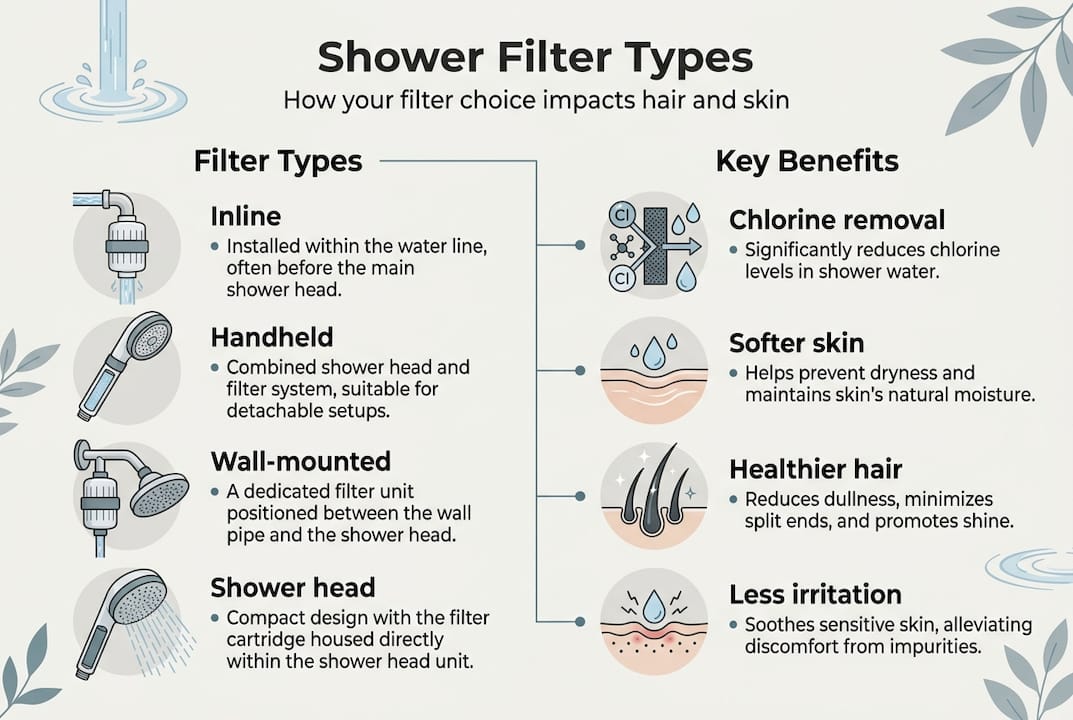
Inline filters attach between your existing shower arm and shower head. They are discreet, easy to install, and compatible with most standard fittings.
Handheld shower filters combine a filtered head with a flexible hose, ideal if you prefer flexibility during your shower.
Wall-mounted multi-stage units house multiple filtration media in a larger canister, delivering higher contaminant reduction and longer cartridge life.
Filtered shower heads integrate filtration directly into the head itself. Convenient, but typically limited in media volume and capacity.
| Filter type | Key media | Hot water performance | Chlorine reduction | Cartridge life |
|---|---|---|---|---|
| KDF-55 inline | KDF-55 | Excellent | High | 6-12 months |
| Calcium sulfite | Calcium sulfite | Very good | High | 3-6 months |
| Activated carbon | Carbon block | Moderate | Moderate | 3-6 months |
| Vitamin C inline | Ascorbic acid | Good | Very high | 1-3 months |
| Multi-stage | KDF-55 + carbon + more | Excellent | Very high | 6-12 months |
KDF-55 is the gold standard for chlorine reduction in shower filters, while calcium sulfite is highly effective specifically in hot water conditions. For Australian city water, a multi-stage filter combining both is the most reliable choice.
Steps to choose the right filter for your situation:
- Identify your water type. City water typically has high chlorine. Rural or bore water may have additional sediment or bacteria concerns.
- Check your shower pressure. Some filters reduce flow rate. Look for models rated to maintain adequate pressure with your existing plumbing.
- Confirm fitting compatibility. Most Australian homes use standard G1/2 inch fittings, but check before buying.
- Prioritise multi-stage media. The PURITI premium shower filter uses five stages of filtration, outperforming single-media alternatives on chlorine and contaminant reduction.
- Consider cartridge availability. A filter is only as good as your ability to replace the media on schedule.
Pro Tip: If you take hot showers, prioritise a filter that includes either KDF-55 or calcium sulfite. Activated carbon alone loses effectiveness above 38 degrees Celsius, which is well within the temperature of a warm Australian shower.
Shopping smart: What certifications and features matter
Marketing claims are everywhere in the filtration category. Certifications are your shortcut through the noise. NSF/ANSI 177 certifies shower filters for at least 50% chlorine reduction, with high-performing models achieving 80% or more over 10,000 gallons of use. If a product cannot point you to this certification, treat its claims with caution.
NSF/ANSI 42 is a secondary certification addressing aesthetic effects: taste, odour, and chlorine levels in drinking water. While less specific to shower filters, it indicates a product has undergone independent third-party testing.
Here is what to prioritise when reviewing filter certification details and product specifications:
| Feature | Why it matters | What to look for |
|---|---|---|
| Certification | Validates performance claims | NSF/ANSI 177 minimum |
| Capacity (gallons/litres) | Determines cartridge replacement frequency | 10,000+ litres per cartridge |
| Flow rate | Impacts shower pressure | 8-10 litres per minute |
| Media stages | More stages = broader contaminant removal | 3-5 stages |
| Warranty | Reflects manufacturer confidence | Minimum 12 months |
Common pitfalls to avoid:
- Uncertified filters: A filter with no third-party testing may do very little, regardless of packaging claims.
- Pressure loss: Cheap filters with fine media can significantly reduce your shower pressure, making them frustrating to use daily.
- Media exhaustion: All filtration media has a capacity limit. Ignoring when to replace cartridges means you are showering through spent, potentially bacteria-harbouring media.
- Incompatible fittings: Always verify the thread size before purchasing to avoid returns or modification costs.
Lab-published performance data, not just marketing copy, is the benchmark worth trusting.
Maintenance tips for lasting beauty results
A shower filter only performs if it is maintained. Filter performance degrades over time, and testing your water while changing filters as rated prevents pressure loss and ensures continued contaminant removal. Most cartridges are rated for 3 to 6 months of typical household use.
Follow these steps to keep your filter performing:
- Note the installation date on your calendar when you first fit a new cartridge.
- Monitor your shower pressure monthly. A noticeable drop often signals that the media is nearing exhaustion.
- Order replacement cartridges before the current one expires so there is no gap in your filtration coverage.
- Rinse new cartridges before use to flush any fine media particles.
Pro Tip: Set a recurring reminder on your phone every 90 days to check your filter. Consistent replacement is the single biggest factor in maintaining the skin and hair benefits you notice in the first weeks of use.
What most guides miss about household filtration and beauty
Most beauty advice focuses on products: the right serum, the best conditioner, the most effective exfoliant. What it almost never addresses is the water delivering those products to your skin every day. In Australia particularly, chlorine-heavy municipal water makes certified, performance-tested shower filters vital for anyone serious about skin and hair improvement.
Conventional beauty wisdom treats water as neutral, a delivery mechanism rather than a variable. But water chemistry is not neutral. High chlorine levels, dissolved metals, and mineral hardness all interact directly with your skin barrier and hair cuticle before any product gets the chance to work. Spending more on premium skincare while ignoring the quality of your shower water is like applying sunscreen over sunburnt skin. The foundation has to be right.
What we have observed is that the women who see the most dramatic improvements from choosing a shower filter for Australian conditions are those who treat it as a baseline rather than a bonus. When you remove the daily chemical load from your shower water, your existing routine simply works better. Prioritising independently tested, certified filters with published performance data is not overcautious. It is the most evidence-based beauty decision you can make.
Ready to upgrade your shower routine?
If the evidence has you thinking about your own shower water quality, the next step is straightforward. PURITI’s 5-stage filtration system is independently lab-tested, with results published publicly, and removes 99.55% of chlorine and contaminants from your shower water.
Shop the premium shower filter to see the full specification, lab results, and compatibility details. You can also explore the full shower solutions range to find everything you need, including the luxe hair towel that pairs perfectly with filtered water for a complete post-shower routine. Your skin and hair will notice the difference within the first few weeks.
Frequently asked questions
What is the difference between a whole house filtration system and a shower filter?
A whole house system treats all water entering your home at the Point-of-Entry, while a shower filter is a Point-of-Use device that targets only the water at your shower fixture. Shower filters are more affordable and targeted for beauty and wellness outcomes.
Do shower filters really improve hair and skin health?
Yes. KDF-55 and other media in quality shower filters remove chlorine and heavy metals, the primary culprits behind dry, dull skin and hair. Most users notice softer hair and calmer skin within the first few weeks of consistent use.
How often should I replace my shower filter cartridge?
Most quality cartridges should be replaced every 3 to 6 months, depending on your household’s water usage and local water quality. Replacing on schedule ensures performance does not degrade and prevents spent media from becoming a contamination risk.
What certification should I look for in a shower filter?
NSF/ANSI 177 is the most relevant certification for shower filters, confirming at least 50% chlorine reduction under standardised testing conditions. NSF/ANSI 42 is a secondary indicator of independently verified performance.


