


QUICK LINKS

How to improve your shower water for healthier hair
TL;DR:
- Hard water and chlorine in tap water can damage hair by causing dryness, frizz, and color fade.
- Using a high-quality shower filter and clarifying shampoo improves water quality and hair health.
- Regular filter cartridge replacement and gentle drying techniques enhance long-term hair benefits.
You invest in quality shampoos, treatments, and conditioners, yet your hair still feels dry, dull, or impossible to manage. If that sounds familiar, the problem may not be your products at all. Your shower water could be quietly undoing everything your haircare routine is trying to achieve. Hard water and high chlorine levels are two of the most overlooked causes of chronic hair frustration for Australian women, and improving your water quality is one of the most direct changes you can make for genuinely better hair health.
Table of Contents
- Why water quality affects your hair
- What you need to improve shower water for hair
- Step-by-step: How to upgrade your water and routine
- Spotting improvements: How to tell your water routine works
- Why most advice on ‘hair water’ misses the mark
- Ready for better hair? Upgrade your water routine with PURITI
- Frequently asked questions
Key Takeaways
| Point | Details |
|---|---|
| Water quality impacts hair | Minerals and chlorine in tap water can lead to dryness, breakage, and less effective hair products. |
| Use a filtered shower head | Installing a shower filter reduces the drying effects of chlorine and minerals for healthier, shinier hair. |
| Pair with haircare upgrades | Combine filtered water with clarifying shampoos and gentle drying techniques for best results. |
| Look for real changes | Watch for softer hair, brighter colour, and a calmer scalp as signs your water upgrade works. |
Why water quality affects your hair
Understanding the problem starts with what’s really in your water and how it affects your daily hair routine.
Australian tap water is treated with chlorine to make it safe to drink, and depending on where you live, it can also carry significant levels of dissolved minerals like calcium and magnesium. When water contains elevated concentrations of these minerals, it’s described as hard water. Both chlorine and mineral build-up create real, measurable problems for your hair and scalp.
Here’s what hard and chlorinated water actually does to your hair:
- Strips moisture: Chlorine breaks down the natural oils that coat each hair strand, leaving it parched and brittle.
- Causes frizz and roughness: Mineral deposits settle on the hair cuticle (the outer protective layer of each strand), forcing it to lift rather than lie flat.
- Creates product build-up: Minerals bind with the ingredients in your shampoo and conditioner, reducing lather and blocking your scalp from absorbing treatments properly.
- Fades colour faster: Chlorine is an oxidising agent, meaning it accelerates colour fade on colour-treated hair significantly.
- Triggers scalp irritation: Chronic exposure to chlorinated water can dry out the scalp, leading to itchiness, flaking, and sensitivity.
Trichologists (hair and scalp specialists) consistently point to water quality as an underestimated variable in hair health. As noted in research on hard water effects on hair, hard water disrupts the hair cuticle and blocks treatments from working as intended. Shower filters reduce chlorine and minerals’ drying effects and enhance product absorption, though they are not true water softeners.
“Hard water disrupts the hair cuticle and blocks treatments from working effectively. Shower filters that reduce chlorine and mineral load can significantly enhance how well your haircare products perform.” — Trichologist perspective, via Prima
Understanding water filtration science gives you a clearer picture of exactly how filters interact with the minerals and chemicals in your shower water, and why multi-stage systems outperform basic alternatives.
What you need to improve shower water for hair
Now that you know why water quality matters, what exactly do you need to start making a positive change?
The good news is that improving your shower water for hair doesn’t require plumbing modifications or a major renovation. Several accessible options exist, each with different performance levels and price points. Here’s a straightforward comparison:
| Option | How it works | Effectiveness for hair | Rental-friendly? |
|---|---|---|---|
| Shower filter | Removes chlorine, heavy metals, and sediment | High | Yes |
| Whole-home water softener | Replaces calcium/magnesium with sodium | Very high | No |
| Filtered shower head | Combines filter media with shower head | Moderate | Yes |
| Vitamin C rinse | Neutralises chlorine after washing | Low to moderate | Yes |
| Clarifying shampoo alone | Removes mineral and product build-up | Moderate | Yes |
For most Australian women, particularly those renting or living in apartments, a dedicated shower filter combined with a clarifying shampoo is the most practical and cost-effective combination. Shower filters reduce chlorine and minerals’ drying effects and enhance product absorption, though they are not the same as true water softeners.
Your essential product list for better hair water:
- A quality shower filter: Look for lab-tested multi-stage filtration (such as KDF-55 and activated carbon stages) with published results. The PURITI Shower Filter is independently tested and removes 99.55% of chlorine, making it one of the highest-performing options available in Australia.
- A clarifying shampoo: Used weekly or fortnightly, a clarifying shampoo dissolves mineral and product build-up that even filtered water may not fully prevent.
- A microfibre hair towel: Conventional terry towelling creates friction on the hair cuticle. A gentle towel reduces mechanical damage after washing.
- A hair and scalp brush: Regular scalp stimulation improves circulation and helps distribute your scalp’s natural oils, supporting the overall health of your hair follicles.
Pro Tip: The most effective approach pairs a high-performance shower filter with a weekly clarifying shampoo. The filter handles what’s in your water. The clarifying shampoo addresses any residual build-up from styling products and environmental exposure. Used together, you’re tackling the problem from two angles at once.
Step-by-step: How to upgrade your water and routine
With your tools ready, let’s break down exactly how to upgrade your water and boost your haircare results.
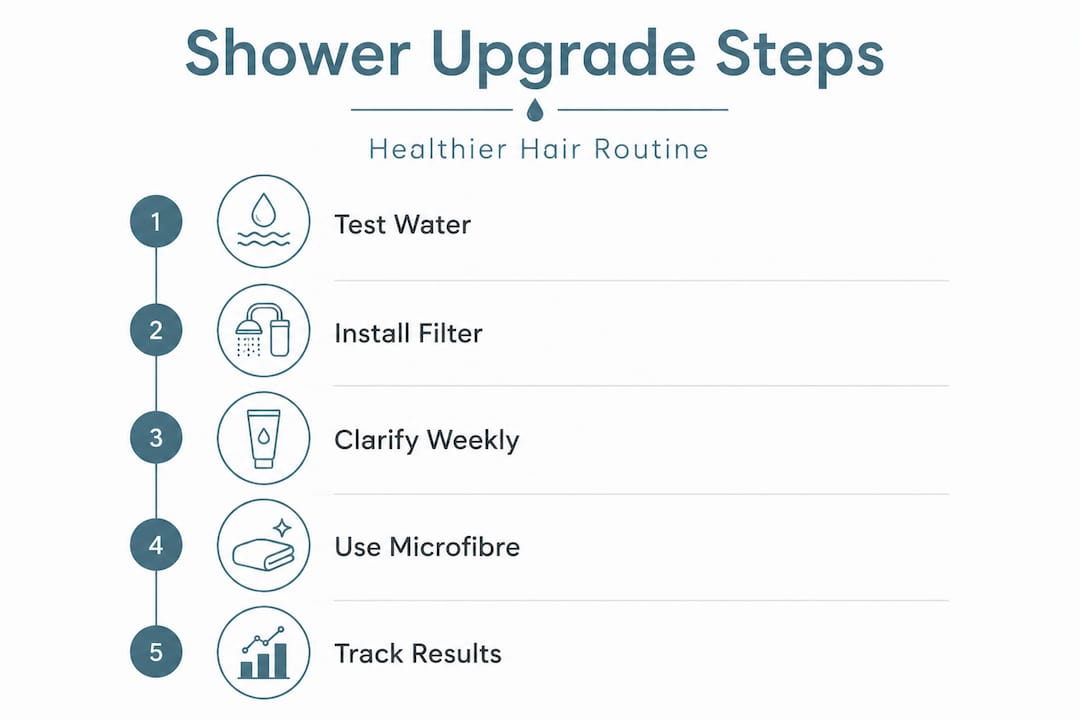
Follow these steps to get your water and routine working together properly:
-
Choose the right filter for your shower. Look for a shower filter with independently verified lab results, a multi-stage filtration system, and compatibility with your existing shower fitting. Not all filters are equal. A five-stage system using KDF-55, calcium sulphite, and activated carbon removes a broader range of contaminants than a basic single-stage filter.
-
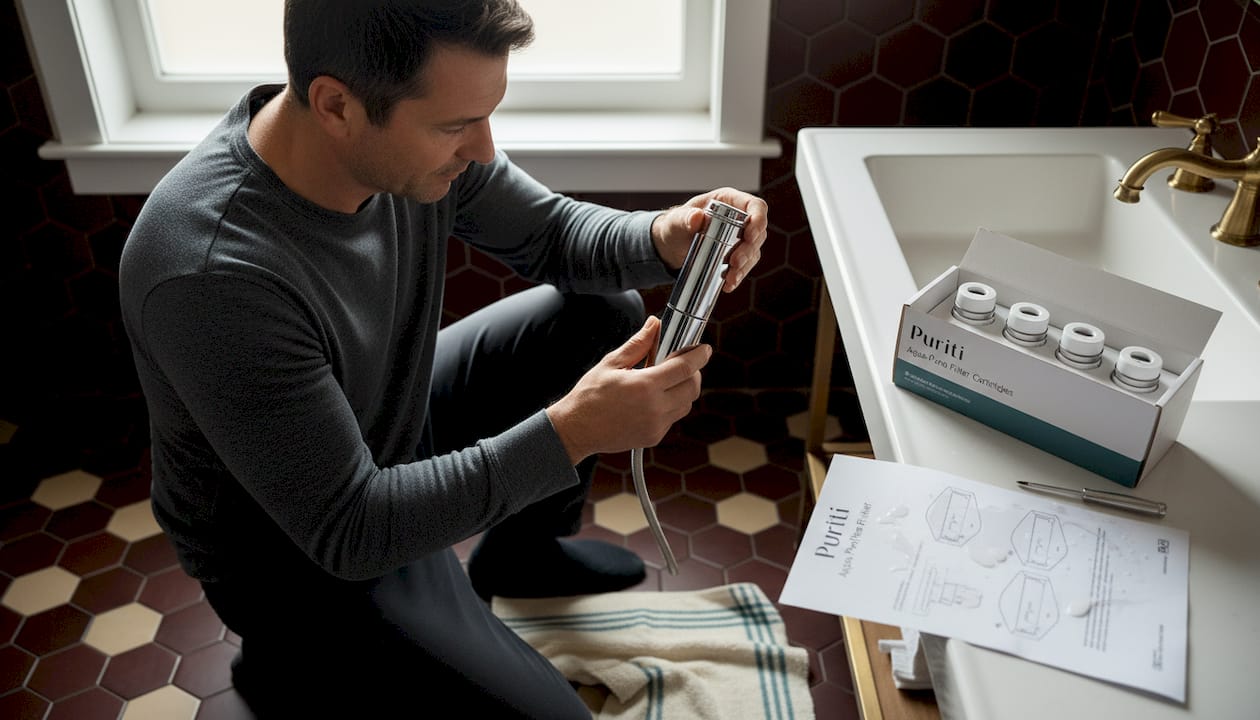
Install your filter. Most quality shower filters connect directly between your existing shower arm and shower head. No tools are needed in the majority of cases. Installation takes roughly five to ten minutes and doesn’t require a plumber.
-
Schedule cartridge replacements. A filter cartridge that’s past its useful life doesn’t just stop working; it can actually begin releasing trapped contaminants back into your water. Staying on top of replacements is essential. Keep a shower filter cartridge on hand so you’re never caught out.
-
Introduce a clarifying shampoo into your wash routine. Research confirms that filters and clarifying shampoos together restore treatment efficacy. Use your clarifying shampoo once per week if you’re in a hard water area, or fortnightly if your water is moderately mineralised.
-
Rinse with cooler water. Hot water opens the hair cuticle, which makes hair more vulnerable to the remaining minerals in your water. Finishing your wash with a cool rinse helps to close the cuticle and lock in moisture and shine.
-
Towel-dry gently with a microfibre hair towel. Rather than rubbing your hair, press and squeeze sections of hair gently. This dramatically reduces mechanical breakage and frizz, especially for fine or colour-treated hair.
Here’s a clear comparison of what your routine looks like before and after the upgrade:
| Routine element | Unfiltered routine | Filtered routine |
|---|---|---|
| Water entering shower | High chlorine, mineral-laden | 99.55% chlorine removed, reduced minerals |
| Product absorption | Blocked by mineral build-up | Improved, cuticle better able to receive treatment |
| Hair texture after washing | Rough, dull, frizzy | Smoother, more manageable |
| Colour retention | Fades faster due to chlorine oxidation | Noticeably extended between colour appointments |
| Scalp condition | Prone to dryness and irritation | Calmer, less reactive |
| Post-wash drying | Cuticle raised, prone to damage | Cuticle smoother, less friction required |
Pro Tip: In Australian cities, water hardness and chlorine levels vary significantly. Sydney’s water tends to be softer, while Melbourne, Adelaide, and Perth water can carry higher mineral loads. If you’re in a higher-hardness area, replace your filter cartridge every 4 to 5 months rather than the standard 6-month cycle. Your cartridge is working harder, and you’ll get better results by keeping it fresh.
Spotting improvements: How to tell your water routine works
After refining your water and routine, how do you know it’s really working for your hair?
Some changes are immediate. Others build over several weeks of consistent use. Here are the positive signals to look for:
- Hair feels softer and lighter after washing, without the sticky or coated residue that hard water can leave behind.
- Your colour looks brighter and lasts longer between appointments, because chlorine is no longer oxidising the dye molecules in your hair.
- Your scalp feels less itchy and irritated, particularly if you’ve been experiencing dryness or flaking that doesn’t respond to standard treatments.
- Your shampoo and conditioner lather more easily, which is a direct sign that mineral interference has been reduced and your products can actually do their job.
- Frizz reduces noticeably, especially in the days following a clarifying wash, as mineral build-up is cleared from the hair shaft.
- Styling products perform better, holding longer and applying more evenly without residue.
PURITI’s independently tested filtration system removes 99.55% of chlorine from shower water, which is one of the highest verified removal rates available from any shower filter on the Australian market. That level of filtration creates a measurable difference in how your water interacts with your hair and scalp from the very first wash.
If you’re not seeing improvements within four to six weeks, there are a few adjustments worth considering. Check that your filter cartridge is still within its performance window. Revisit how often you’re using your clarifying shampoo. And consider whether your regular conditioner or treatment is compatible with your hair type.
“If the hair cuticle remains rough, colour continues to fade rapidly, or scalp irritation persists after switching to filtered water, it’s worth reviewing your entire product stack. Treatments that perform well in soft water may behave differently in mineralised conditions.” — Trichologist guidance, via hard water effects on hair
Pairing your filtered shower with the Hair Ritual Bundle ensures your accessories and tools are matched to the same standard as your water quality, giving your hair routine a cohesive foundation rather than a patchwork of mismatched products.
Why most advice on ‘hair water’ misses the mark
Knowing what to look for also means questioning the common advice floating around online.
A significant amount of content about water and hair health defaults to recommending whole-home water softeners as the gold-standard solution. That advice may be accurate in theory, but it’s almost entirely irrelevant to the reality most Australian women are living in. Whole-home softeners require installation in properties where you own the plumbing, cost thousands of dollars upfront, and involve ongoing maintenance that’s simply not practical for renters or apartment dwellers, which accounts for a substantial portion of the Australian population.
The more useful and honest conversation centres on what you can actually control. A shower filter is a genuinely accessible solution. It installs in minutes, works with any standard shower fitting, requires no landlord approval in most cases, and delivers measurable results without any permanent changes to your home. As the evidence consistently shows, shower filters reduce chlorine and minerals’ drying effects and significantly improve product absorption, even if they don’t technically soften water in the way an ion-exchange system does.
The other thing much of the online advice gets wrong is treating a shower filter as a complete solution on its own. It isn’t, and we’ll be direct about that. A filter handles the chemistry of your water. It doesn’t address product build-up from styling sprays, dry shampoos, or leave-in treatments. That’s where your clarifying shampoo becomes essential. It doesn’t address mechanical damage from rough towels or heat tools. That’s where your accessories matter. The filter is the foundation, not the entire structure.
Australian water also has specific characteristics that generic international advice doesn’t account for. Municipal treatment practices, seasonal variations in chlorine dosing, and regional differences in mineral content all affect how your hair responds. When comparing shower filters designed and tested specifically for the Australian market, you’ll see meaningful differences in filtration performance, build quality, and compatibility with local water conditions compared to imported alternatives.
Focus on what’s within your control: a high-quality shower filter, a consistent clarifying wash, and accessories that support rather than undermine your results. That’s where real, visible improvement comes from.
Ready for better hair? Upgrade your water routine with PURITI
When you’re ready for real change, it makes sense to choose solutions designed for Australian haircare conditions.
PURITI’s five-stage shower filter is independently lab-tested and removes 99.55% of chlorine from your shower water, with results published publicly so you can verify the performance yourself. It’s built from aluminium titanium alloy, designed to sit elegantly in a premium bathroom, and engineered specifically for Australian water conditions.

Start with the PURITI shower filter as your Step Zero, then build out your routine with a microfibre hair towel to reduce mechanical damage and filter cartridge refills to keep your filtration performing at its peak. If you want to explore the full range of hair and shower accessories designed to work alongside filtered water, the complete shower collection is a good place to start. Your haircare products deserve filtered water to work in. Give them that foundation.
Frequently asked questions
What is hard water and why does it matter for hair?
Hard water contains elevated levels of minerals like calcium and magnesium that coat the hair shaft, cause dryness and frizz, and prevent product absorption, making even premium treatments less effective.
How do I know if my water is damaging my hair?
Signs include persistent dryness, increased breakage, rapid colour fade, or poor lather from your shampoo. Trichologists note that hard water disrupts the cuticle and blocks treatments, so those are the first places to look.
Will a shower filter soften my water?
Shower filters significantly reduce chlorine and minerals’ drying effects and improve product absorption, but they are not true softeners in the same way an ion-exchange system is.
How often should I replace a shower filter cartridge?
Replace your cartridge roughly every 6 months under standard use, or every 4 to 5 months if you’re in a high-mineral or high-chlorine area, to maintain consistent filtration performance.
Can improving water for hair help with scalp issues?
Yes. Removing chlorine and reducing mineral build-up can calm scalp irritation and improve the absorption of scalp treatments. Trichologists confirm that hard water blocks treatments from working properly, so cleaner water creates a healthier environment for both hair and scalp.


