


QUICK LINKS

Water softening vs filtration: best for skin and hair
TL;DR:
- Australian cities like Perth, Adelaide, and Sydney have hard water and chlorine that damage skin and hair.
- Water softeners reduce mineral buildup but do not remove chlorine, while filtration better addresses chemical irritants.
- Using a quality shower filter can improve skin clarity, reduce hair frizz, and enhance overall hair and skin health.
If you live in Perth, Adelaide, or Sydney, the water coming from your showerhead may be doing more damage to your hair and skin than you realise. Hard water and chlorine are standard features of Australian metropolitan water supplies, yet most beauty routines never account for them. Water softening and filtration are two very different solutions, and choosing the wrong one means you could keep spending on serums and treatments without ever fixing the root cause. This guide breaks down exactly how each approach works and which delivers the best results for your hair and skin.
Table of Contents
- Australian water quality and its effect on your hair and skin
- What is water softening and does it help your beauty routine?
- What does filtration actually do for your hair and skin?
- Water softening vs filtration: side-by-side beauty comparison
- Our perspective: why the beauty industry is talking more about filtration, not just softening
- Ready to transform your hair and skin? Discover your next steps
- Frequently asked questions
Key Takeaways
| Point | Details |
|---|---|
| Hard water is common | Many Australian cities have hard, chlorinated water that can damage hair and skin. |
| Softening vs filtration | Softening removes minerals, while filtration targets chlorine and chemicals for beauty benefits. |
| Filtration often wins for beauty | Filtration addresses more beauty concerns and is favoured for brighter skin and softer hair. |
| Choose by your region | Consider your city’s water profile when deciding between softening or filtration. |
Australian water quality and its effect on your hair and skin
When water contains high concentrations of dissolved minerals, particularly calcium and magnesium, it is classified as hard water. These minerals are naturally occurring and entirely safe to drink, but they interact poorly with your skin and hair. They leave a film that blocks pores, strips moisture, and causes hair cuticles to roughen and break. Chlorine, which is added by water treatment facilities to kill bacteria, compounds the problem by irritating the skin barrier and stripping natural oils from the scalp.
Australian cities vary considerably in water filtration basics and overall water hardness. Understanding your city’s water profile is the first step toward choosing the right solution.
| City | Hardness (mg/L) | Chlorine treated? | Key concern |
|---|---|---|---|
| Perth | 180 to 250 | Yes | High hardness and chlorine |
| Adelaide | 180 to 230 | Yes | High hardness and chlorine |
| Sydney | 50 to 75 | Yes | Low hardness, chlorine present |
| Melbourne | 10 to 26 | Yes | Very soft, chlorine present |
| Brisbane | 100 to 150 | Yes | Moderate hardness and chlorine |
Perth and Adelaide sit firmly in the hard water category at 180 to 250 mg/L, while Melbourne enjoys notably softer water. Chlorine, however, is a constant across all major cities regardless of hardness level.
The beauty consequences of hard water and chlorinated water are well documented. For skin, regular exposure leads to dryness, tightness, and inflammation. Women with sensitive skin or eczema often notice that their symptoms worsen when they move to a harder water area. For hair, the mineral deposits coat the shaft, making it appear dull and feel rough to the touch. Over time, mineral buildup weakens the cuticle and increases breakage and frizz, particularly for colour-treated or chemically processed hair.
“The water you wash with is just as important as the products you apply. Mineral-laden, chlorinated water can undo the work of even the most carefully chosen skincare and haircare routine.”
For many Australian women, persistent skin irritation and hair frustration are not product problems. They are water problems. Now that you know why water quality matters, let us explore how softening and filtration actually work.
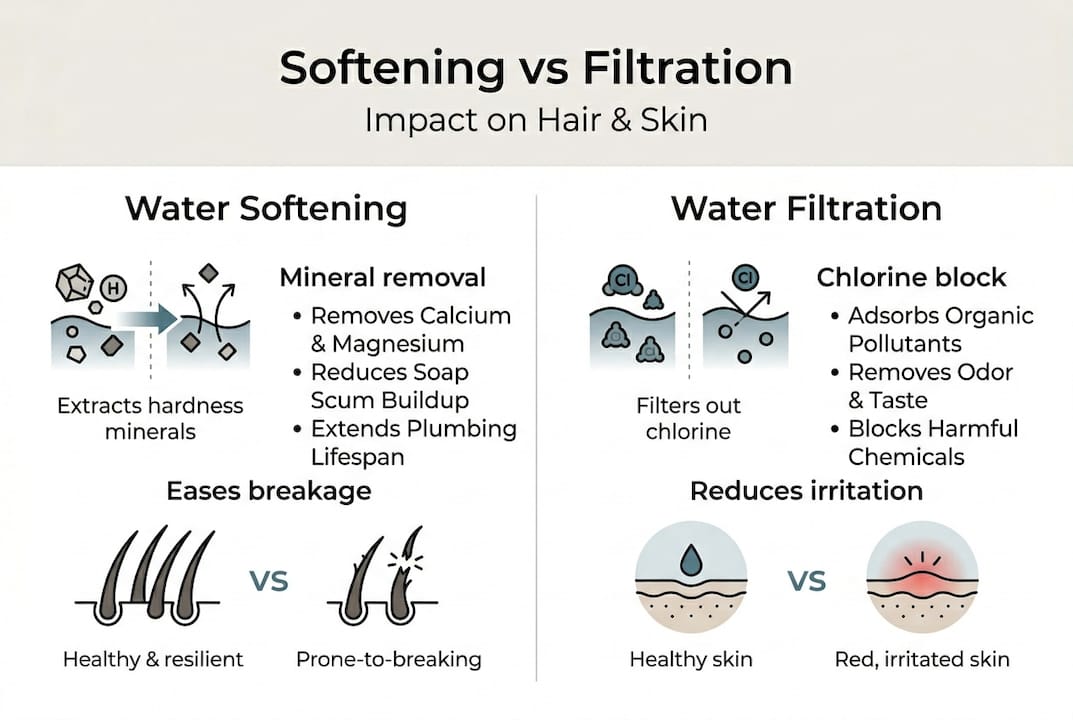
What is water softening and does it help your beauty routine?
Water softeners work through a process called ion exchange. A resin tank filled with sodium or potassium ions swaps out the calcium and magnesium ions responsible for hardness. The result is water with a significantly lower mineral content, which feels noticeably different on the skin and produces a richer lather with soap and shampoo.
For beauty routines, softened water offers some genuine advantages:
- Reduced mineral film on skin and hair after washing
- Better product performance as shampoo and conditioner lather more effectively in soft water
- Less residue left on the scalp, which can reduce some types of dullness
- A softer tactile feel to the water that many users find more pleasant
However, water softening has clear limits that are important to understand. Hard water mostly causes breakage and dullness through mineral buildup rather than triggering hair loss, but softening alone does not fix every issue. Critically, softeners do not remove chlorine. They also do not address heavy metals, volatile organic compounds, or other chemical contaminants. So if your main concern is skin irritation, scalp sensitivity, or chemical exposure, a softener will not resolve it.
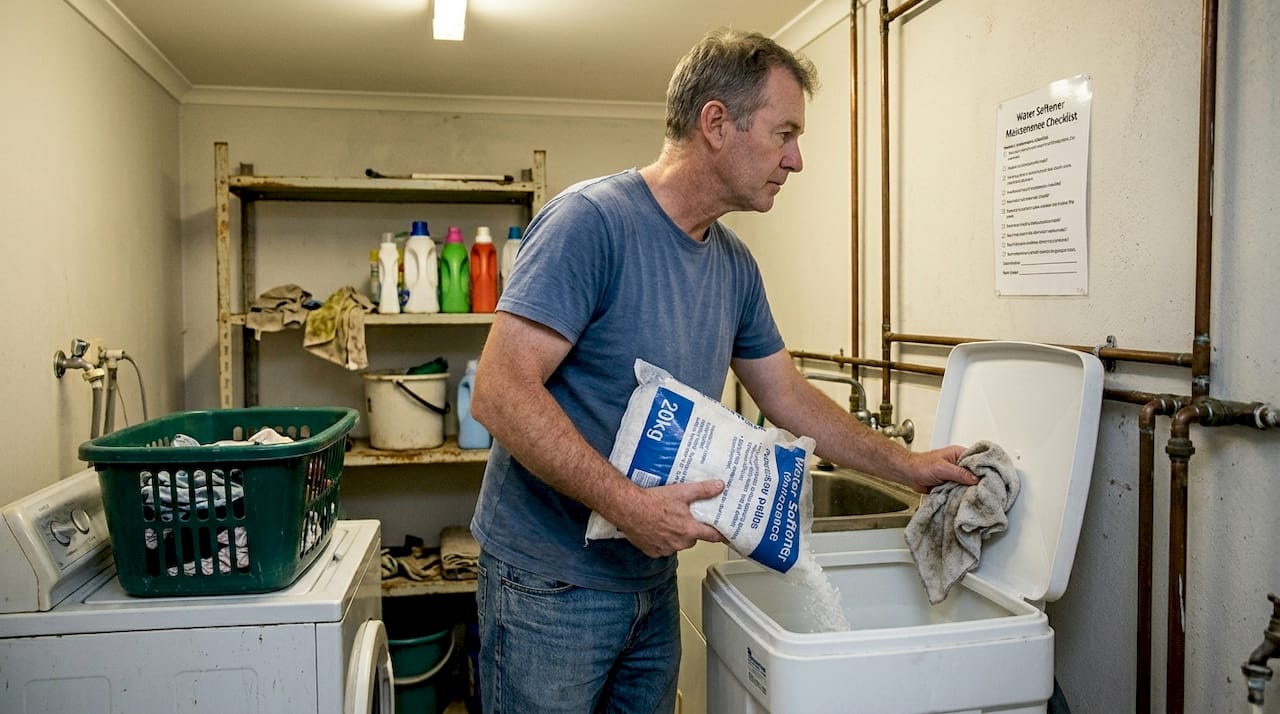
Some salt-based softeners add a slight sodium residue to the water, which can actually contribute to dryness for people with already sensitive skin. The Australian water study notes that while softened water reduces mineral-related concerns, chemical contaminants including chlorine remain untouched without additional filtration.
Whole-house water softeners also require ongoing maintenance, regular salt top-ups, and a meaningful upfront installation cost. They are a plumbing decision as much as a beauty one.
Pro Tip: If you live in a high-hardness city like Perth or Adelaide, softening can reduce mineral-related hair and skin issues. But without chlorine removal, you are still exposing your skin to one of the most common irritants in your daily routine.
With softening’s role clarified, let us look at filtration, an approach gaining real traction in beauty circles.
What does filtration actually do for your hair and skin?
Water filtration works differently from softening. Rather than replacing minerals, filtration physically or chemically removes specific contaminants from your water. Activated carbon is the most common filtration medium, and it is highly effective at adsorbing chlorine, chloramines, and certain volatile organic compounds. Multi-stage filters like PURITI’s 5-stage system also incorporate KDF-55 media, which uses a redox reaction to neutralise heavy metals and inhibit bacterial growth.
The distinction matters enormously for beauty outcomes. Filtered water can measurably improve dryness, dullness, and skin irritation. While large-scale clinical trials are limited, expert consensus and real-world feedback consistently point to meaningful benefits, particularly for women dealing with reactive skin or scalp sensitivity.
Here is what many women report noticing after switching to filtered shower water:
- Brighter, more even skin tone with reduced redness after showering
- Less frizz and improved hair manageability, particularly for fine or colour-treated hair
- Fewer clogged pores as chemical residue no longer sits on the skin
- Reduced scalp irritation and less reliance on medicated shampoos
- Softer-feeling hair within a handful of washes
The reach of this issue is significant. Over 90% of Australian metropolitan residents receive chlorinated tap water, making chemical exposure through showering a near-universal concern. The hard water impact compounds the problem for residents in harder water cities.
It is worth noting that results do vary. A basic single-stage carbon filter will perform very differently from a certified multi-stage system. The quality of your local water supply also influences how dramatic the improvement feels. For the most consistent outcome, look for shower filter benefits that include lab-tested performance data and independent verification.
Filtration is also practically simpler than softening for most households. A quality shower filter attaches directly to your existing showerhead, requires no plumbing work, and can be replaced in minutes. Understanding the science behind filtration helps you assess which filter type will address your specific water concerns.
With both strategies explored, it is helpful to see how softening and filtration compare directly for beauty outcomes.
Water softening vs filtration: side-by-side beauty comparison
Choosing between softening and filtration comes down to your city’s water profile, your primary beauty concerns, and how much disruption you are willing to accept in your home. The following comparison lays out the key differences.
| Factor | Water softener | Shower filter |
|---|---|---|
| Removes hardness minerals | Yes | Partially (depends on filter) |
| Removes chlorine | No | Yes (activated carbon) |
| Removes heavy metals | No | Yes (KDF-55 media) |
| Installation complexity | High (plumbing) | Low (DIY, minutes) |
| Ongoing maintenance | High (salt refills) | Low (cartridge swap) |
| Cost | $1,000 to $4,000+ | $100 to $300 |
| Skin irritation relief | Partial | Strong |
| Hair improvement | Moderate | Strong |
| Chlorine protection | None | Yes |
For beauty-focused priorities, here is how the factors rank from most impactful to least:
- Chlorine removal delivers the broadest skin and hair benefits for the majority of Australian women
- Heavy metal reduction matters most for women with reactive skin or scalp conditions
- Mineral hardness reduction is most relevant in high-hardness cities like Perth and Adelaide
- Ease of use and low maintenance determines long-term consistency
- Cost influences whether a solution is sustainable over time
Australian hard water causes eczema flare-ups, dry skin, and hair dullness, and chlorine is present across every major city regardless of hardness. That combination means a quality shower filter addresses more beauty concerns for more Australian women than a softener alone. The filter comparison guide can help you identify which specific filter matches your water supply and skin type.
Now, let us wrap up with expert advice for choosing what works best for your body and routine.
Our perspective: why the beauty industry is talking more about filtration, not just softening
The conversation in wellness and beauty circles has shifted noticeably. Softeners have been around for decades, and they solve a real problem for households in high-hardness cities. But they were never designed with skin and hair in mind. They were designed for appliances and plumbing.
Filtration, by contrast, targets exactly the contaminants that most affect your complexion and hair condition. Chlorine is the most pervasive and arguably the most damaging, and it is entirely absent from a softener’s job description. Consistent anecdotal and expert agreement confirms that beauty benefits from water treatment are real, but softening alone is not a complete answer.
What we see increasingly in the wellness community is women combining a quality shower filter with targeted topical routines and noticing faster, more sustained improvements than they ever achieved with premium products alone. A high-performance shower filter is often the element that makes everything else in a routine work better. Understanding the science behind beauty filtration makes it clear why this is the case.
Pro Tip: Think of your shower filter as Step Zero. Before any serum, mask, or treatment can work optimally, the water delivering it to your skin needs to be clean.
Ready to transform your hair and skin? Discover your next steps
If this guide has clarified anything, it is that what comes out of your showerhead matters as much as what you put on your skin afterwards. A premium shower filter removes 99.55% of chlorine and contaminants across five independently tested filtration stages, giving every product in your routine a cleaner canvas to work with.
PURITI’s full range of shower upgrades is designed to sit seamlessly within a premium bathroom and support a complete wellness routine. Pair your filter with a hair towel for healthier locks to reduce friction and breakage after every wash. When your water is cleaner, every step that follows works harder.
Frequently asked questions
Does water softening remove chlorine and make water safe for sensitive skin?
No. Water softeners address mineral hardness through ion exchange but do not remove chlorine. A dedicated filter using activated carbon is required to reduce chlorine exposure for sensitive skin.
Is there evidence that filtered water helps with eczema or skin irritation?
Yes. Studies and expert consensus link hard, chlorinated water to increased eczema risk and skin irritation, and many users report measurable symptom reduction after installing a quality shower filter.
Will installing a shower filter improve hair health instantly?
Many women notice softer, more manageable hair within a few washes, though results depend on the filter’s performance rating, your local water hardness, and your individual hair type.
Should I choose a water softener or shower filter if I live in Melbourne?
Melbourne has very soft water, so mineral hardness is less of a concern. A quality shower filter focused on chlorine removal will deliver the most relevant skin and hair benefits for Melbourne residents.


