


QUICK LINKS

How multi-stage filtration transforms hair and skin
TL;DR:
- Multi-stage shower filters remove multiple contaminants, benefiting hair and skin health significantly.
- Proper filter maintenance and replacement are crucial for sustained filtration performance.
- Choosing the right filter depends on specific water quality issues and personal beauty goals.
Not all shower filters are built the same, and the difference matters far more than most people realise. Many women invest in premium shampoos, serums, and skincare, yet their shower water continues to strip colour, dry out skin, and contribute to scalp irritation before a single product is applied. Multi-stage filtration uses sequential stages with distinct filter media to target different contaminants, making it a fundamentally different solution to the basic single-cartridge filters sold at hardware stores. This article explains how each stage works, why the order of filtration matters, and how to match a system to your actual water quality and beauty goals.
Table of Contents
- Why water quality matters for hair and skin
- How multi-stage filtration works in your shower
- Multi-stage filtration vs. single-stage: What’s the difference?
- Real impact: How multi-stage filtration transforms your beauty routine
- What most people get wrong about shower filtration for beauty
- Find your perfect filtration fit with PURITI
- Frequently asked questions
Key Takeaways
| Point | Details |
|---|---|
| Broader contaminant removal | Multi-stage shower filters are effective because they target a wider range of impurities that affect hair and skin. |
| Stage order matters | Proper sequencing of filtration stages maximises performance and protects sensitive media for lasting results. |
| Beauty benefits | Expect softer hair, fewer breakouts, and brighter skin when using multi-stage filtration in your shower. |
| Match filter to water | Test your water or check your main concerns to choose the right level of filtration for your needs. |
Why water quality matters for hair and skin
Your tap water is treated before it reaches your showerhead, but treated does not mean clean in the way your hair and skin need it to be. Municipalities across Australia add chlorine or chloramines to disinfect water, and while this is necessary for safety, chlorine is also a powerful oxidising agent. It strips the natural oils from your scalp, weakens the keratin protein structure in each hair strand, and disrupts the skin’s moisture barrier. The result shows up as frizz, colour fade, dryness, and increased sensitivity.
Beyond chlorine, the water in your home can carry a range of other impurities depending on your location and pipe age. Common concerns include:
- Chlorine and chloramines: The leading cause of dry scalp, brittle ends, and colour fade for colour-treated hair
- Heavy metals (iron, copper, lead): Bind to hair fibres and cause discolouration, dullness, and breakage; iron in particular turns blonde hair brassy
- Sediment and particulates: Block follicles, create scalp congestion, and leave a film on skin that interferes with moisturiser absorption
- Calcium and magnesium (hard water minerals): Build up on the hair shaft, making it feel rough and reducing the effectiveness of conditioning treatments
Hard water affects a significant portion of Australian households, particularly in Adelaide, Perth, and parts of Melbourne. The effects are cumulative. You may not notice the damage after one shower, but over weeks and months, the impact on hair texture, skin tone, and product performance becomes pronounced.
Understanding water filtration and beauty as interconnected is the first step. Shower filters use sequential stages to remove specific harmful elements affecting hair and skin, which is precisely why the design of your filter matters as much as the decision to use one.
Worth knowing: Even if your suburb has relatively low chlorine levels, ageing pipes can introduce iron and sediment into the water that reaches your showerhead.
With the stakes for your hair and skin set, let’s unravel how multi-stage filtration targets the problem at its source.
How multi-stage filtration works in your shower
Multi-stage filtration is not about adding more media into a single cartridge. It is about placing specific filter materials in the correct sequence so that each stage can do its job without interference from contaminants that should have been caught earlier. The order is not arbitrary.
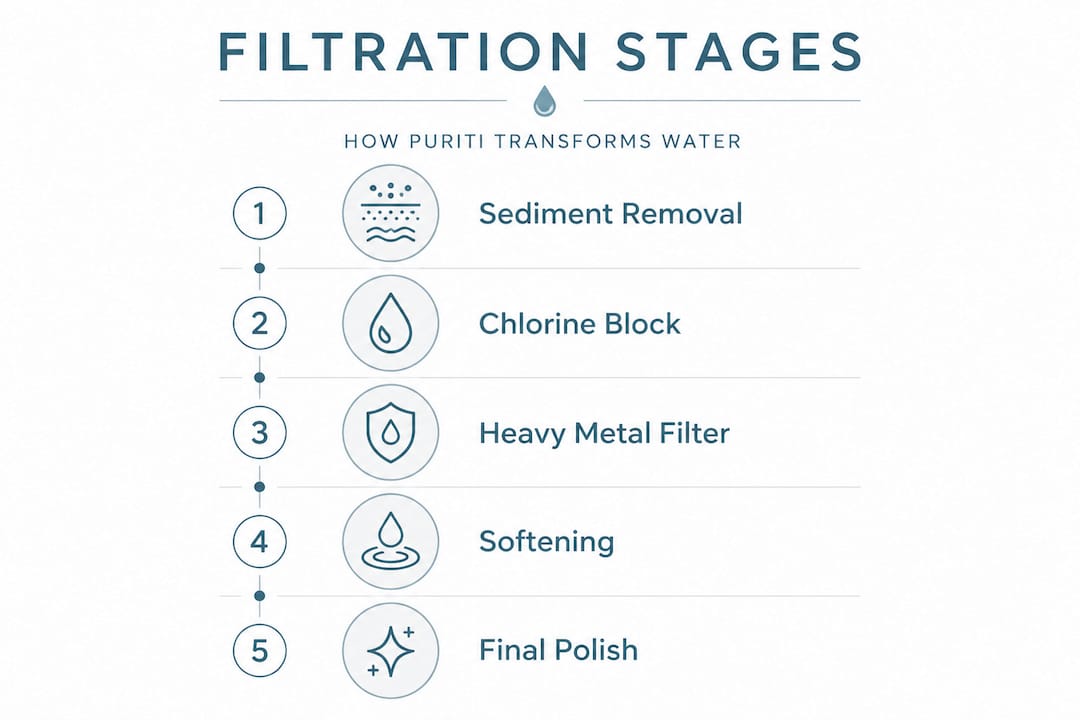
Here is how a quality multi-stage system progresses through each stage:
- Stage 1: Sediment filtration Physical particulates, rust, and debris are captured by a fine mesh or fibre layer. This stage protects all downstream media from clogging, which would otherwise reduce flow rate and shorten filter life significantly.
- Stage 2: Activated carbon Activated carbon adsorbs chlorine, chloramines, volatile organic compounds (VOCs), and some pesticide residues. The enormous surface area of activated carbon (one gram contains around 500 square metres of surface area) makes it exceptionally effective at trapping chemical impurities.
- Stage 3: KDF-55 KDF-55 is a high-purity copper-zinc alloy that works via a redox (reduction-oxidation) reaction to convert free chlorine into harmless chloride. It also inhibits bacterial growth within the filter itself, which is a critical quality consideration for a warm, wet environment like your shower.
- Stage 4: Specialist media (e.g. calcium sulphite or vitamin C) These additional layers target heavy metals, dissolved solids, and chloramines that activated carbon may not capture fully. Calcium sulphite, for instance, neutralises chlorine effectively even at higher water temperatures, which is important because hot showers can reduce the performance of carbon-based filtration.
- Stage 5: Polishing layer A final polishing stage removes any residual fine particles and improves water clarity before it reaches your scalp and skin.
| Filtration stage | Primary media | Contaminants targeted |
|---|---|---|
| Stage 1: Sediment | Fibre mesh | Rust, debris, particulates |
| Stage 2: Carbon | Activated carbon | Chlorine, VOCs, odour |
| Stage 3: Redox | KDF-55 | Chlorine, heavy metals, bacteria control |
| Stage 4: Specialist | Calcium sulphite / vitamin C | Chloramines, residual metals |
| Stage 5: Polish | Fine filtration media | Micro-particles, clarity |
The key insight is that sediment removal first, then activated carbon and KDF, followed by advanced specialist media for heavy metals and bacteria, is the proven sequence for effective multi-contaminant removal. Skip the sediment stage and your carbon media fouls quickly. Skip KDF and bacteria can colonise the warm interior of your filter housing.
Pro Tip: Check whether your shower filter specifies its filtration media by name. Vague claims like “multi-layer” or “advanced filtration” without listing the actual media (activated carbon, KDF-55, calcium sulphite) are a red flag that the filter may not perform as described.
PURITI’s premium shower filter publishes its lab-certified results publicly, making it straightforward to verify exactly what is being removed and at what rate. The refill cartridge is designed to maintain full filtration performance across its rated lifespan, not just at initial installation.
Now that you know the basics, see how multi-stage systems compare to other filter types in effectiveness and fit.
Multi-stage filtration vs. single-stage: What’s the difference?
Single-stage filters typically use activated carbon or KDF alone. They are compact, affordable, and effective for one primary concern. If your water quality report shows high chlorine but low heavy metals, a single-stage carbon filter may give you a meaningful improvement.
The challenge is that most Australian water supplies carry more than one type of contaminant, and the effectiveness of single-stage media against mixed impurities is limited. Activated carbon does not remove heavy metals reliably. KDF alone does not address all chloramine variants. Single-stage filters also tend to exhaust faster when facing higher contamination loads because there is no upstream pre-filtration protecting the primary media.
| Feature | Single-stage filter | Multi-stage filter |
|---|---|---|
| Contaminants targeted | 1 to 2 types | 5 or more types |
| Filter lifespan | Often shorter (higher load on one layer) | Longer (load distributed across stages) |
| Cost | Lower upfront | Higher upfront, better value long-term |
| Best for | Single known contaminant | Mixed or unknown water quality |
| Beauty impact | Moderate | Significantly higher |
| Install difficulty | Easy | Easy (same process) |
As one water quality specialist notes:
“Proper ordering is critical: sediment must go first to prevent downstream fouling; multi-stage is superior for mixed contaminants.”
The practical takeaway: choosing your filter type should start with understanding your local water. Most council websites publish annual water quality reports, and private water testing kits are inexpensive. If you are in a region with hard water, older infrastructure, or water from a reservoir rather than a groundwater source, multi-stage filtration is almost certainly the more appropriate choice.
Choose a single-stage filter if:
- You have a confirmed single contaminant issue (chlorine only)
- Budget is the primary constraint
- You are in a region with consistently high water quality
Choose a multi-stage filter if:
- You have colour-treated, fine, or chemically processed hair
- You experience skin sensitivity or recurring breakouts
- Your water comes from aged pipes or a mixed treatment system
- You want to maximise the investment you make in premium skincare and hair products
Armed with this comparison, you can now choose based on your hair, skin, and water needs. But what does a real upgrade look like in your self-care routine?
Real impact: How multi-stage filtration transforms your beauty routine
The tangible results of switching to multi-stage filtration are not subtle once you know what to look for. Women who make the switch often notice changes within two to four weeks of consistent use. Here is what changes, and why.
- Hair feels softer and stronger Without chlorine stripping keratin and heavy metals binding to the hair shaft, the cuticle layer lies flatter. Hair reflects more light, tangles less, and retains moisture between washes more effectively.
- Colour stays truer for longer Chlorine accelerates colour fade by oxidising the pigment molecules deposited during colour treatment. Filtered water significantly slows this process, meaning less frequent salon visits for colour-treated hair.
- Skin feels calmer after showering The tight, dry sensation after a hot shower is largely a chlorine response. With chlorine removed, skin retains its natural oils and the moisture barrier remains intact, which reduces redness and irritation for sensitive skin types.
- Skincare products absorb better This is one of the less obvious benefits. When a film of minerals and chlorine residue sits on the skin’s surface, it acts as a partial barrier against serums and moisturisers. Filtered water leaves skin clean at a microscopic level, allowing active ingredients to penetrate more effectively.
- Scalp health improves over time Reduced chlorine exposure lowers scalp inflammation, which can contribute to reduced shedding and a healthier environment for hair growth.
Multi-stage filtration removes both physical particulates and chemical impurities, and this dual action is what drives the improvement in hair and skin outcomes. A filter that addresses only one category of contaminant delivers only partial results.
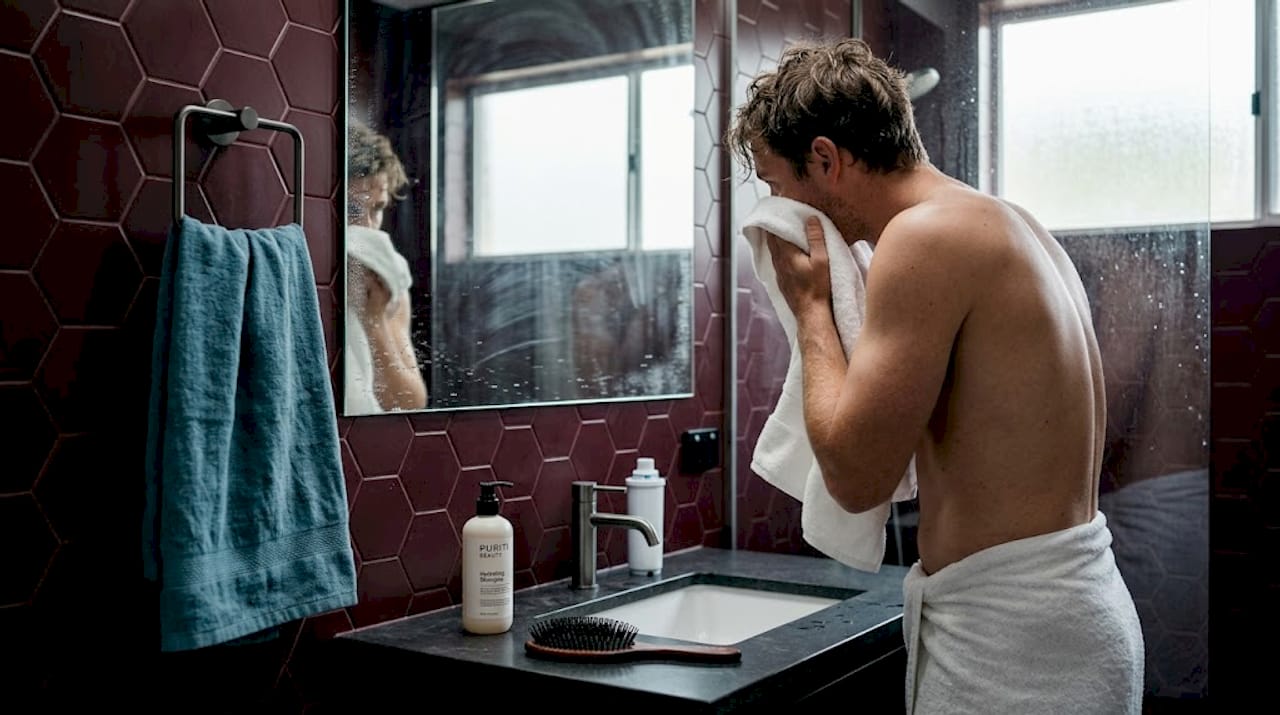
Pro Tip: Pairing filtered shower water with a complete hair ritual that includes targeted treatments amplifies the results significantly. Filtered water means your treatments are working from a clean base rather than fighting against mineral and chemical buildup. Finishing with a luxe microfibre waffle hair towel reduces friction drying and locks in the benefits of your wash routine.
Stepping back, what most guides miss is how filter choices and filter maintenance shape long-term results.
What most people get wrong about shower filtration for beauty
Here is a perspective that tends to get overlooked in the standard discussion of shower filters: more stages does not automatically mean better results for every person.
Multi-stage filtration is not always superior if you have only one major water concern. A customer in a high-quality water region with city-treated supply and newer pipes may not see a meaningful difference between a premium five-stage system and a well-specified single-stage carbon filter. The decision should be grounded in your actual water characteristics, not the number printed on the box.
What does matter universally is filter maintenance. This is the area where most users undermine their own results. A shower filter cartridge that is past its rated lifespan does not simply stop working overnight. It degrades gradually. Exhausted carbon media can release trapped contaminants back into the water. Saturated KDF loses its redox efficiency. A clogged sediment layer reduces flow to the point where water bypasses the filtration media entirely. The filter looks the same from the outside, but the water quality it delivers is substantially worse.
Our community of Australian women who get the best long-term results from their filters share a few consistent habits. They note the installation date on their filter housing (a simple piece of masking tape works). They replace their filter cartridge on a consistent schedule, typically every three to six months depending on usage. And they do not assume that because their hair and skin feel fine, the filter is still performing. The effects of gradual filtration decline are cumulative and often only obvious in retrospect.
The other overlooked sign that your current filter is no longer the right fit: changes in your water supply. Municipal water treatment does change, and seasonal variations in source water quality can shift the contaminant profile of what reaches your home. If you notice your hair becoming dull again or your skin reacting after a period of clear improvement, it is worth investigating whether the filter has been exhausted or whether your water has changed rather than assuming the filter was never effective.
A beauty-first approach to filtration means treating your shower filter the same way you treat your skincare routine: consistently, thoughtfully, and with attention to what your hair and skin are telling you.
Find your perfect filtration fit with PURITI
Understanding multi-stage filtration is one thing. Having the right system in your bathroom is another.

PURITI’s premium shower filter is independently lab-tested with results published publicly, removing 99.55% of chlorine and a broad spectrum of contaminants through a five-stage aluminium titanium alloy housing designed specifically for Australian bathrooms. Maintenance is straightforward with the PURITI refill cartridge, engineered to deliver consistent performance across its full rated lifespan. For those ready to build a complete wellness routine from the ground up, the everyday wellness bundle brings together the filter and supporting accessories in one step. Every PURITI product is backed by transparent performance data and ongoing customer support.
Frequently asked questions
Does multi-stage filtration really make a difference compared to a basic shower filter?
Yes. Multi-stage systems remove more types of contaminants than single-stage filters, giving you clearer, more consistent benefits for both hair and skin health over time.
How often should I replace my shower filter cartridge?
Most shower filter cartridges need replacing every three to six months, depending on your household’s water usage and the contaminant load in your local water supply.
Which water contaminants most affect hair and skin in Australia?
Chlorine, heavy metals such as iron and copper, and sediment particulates are the most common culprits. Multi-stage filtration targets all three categories within a single system.
Can I install a multi-stage shower filter myself?
Yes. Most premium shower filters, including PURITI, are designed for tool-free installation and connect directly to your existing showerhead fitting without any plumbing knowledge required.
Do I need a multi-stage filter if my only concern is chlorine?
A quality single-stage carbon filter may be sufficient if chlorine is genuinely your only concern. However, multi-stage is superior for mixed contaminants, and most Australian water supplies contain more than one type of impurity worth addressing.


